Showing posts with label open-access. Show all posts

Wednesday, March 4

Why TV Lost

Rarely do you see things put so susinctly. Sometimes I could just kiss Paul Graham, but that would be kind of weird and creepy. :)

He captures the inevitability of the TV vs. Internet war, the sheer obviousness and the magic and slaps it all down in a few hundred words like it was meant to be.

From: Why TV Lost
About twenty years ago people noticed computers and TV were on a collision course and started to speculate about what they'd produce when they converged. We now know the answer: computers. It's clear now that even by using the word "convergence" we were giving TV too much credit. This won't be convergence so much as replacement. People may still watch things they call "TV shows," but they'll watch them mostly on computers.

What decided the contest for computers? Four forces, three of which one could have predicted, and one that would have been harder to.

One predictable cause of victory is that the Internet is an open platform. Anyone can build whatever they want on it, and the market picks the winners. So innovation happens at hacker speeds instead of big company speeds.

The second is Moore's Law, which has worked its usual magic on Internet bandwidth. [1]

The third reason computers won is piracy. Users prefer it not just because it's free, but because it's more convenient. Bittorrent and YouTube have already trained a new generation of viewers that the place to watch shows is on a computer screen. [2]

The somewhat more surprising force was one specific type of innovation: social applications. The average teenage kid has a pretty much infinite capacity for talking to their friends. But they can't physically be with them all the time. When I was in high school the solution was the telephone. Now it's social networks, multiplayer games, and various messaging applications. The way you reach them all is through a computer. [3] Which means every teenage kid (a) wants a computer with an Internet connection, (b) has an incentive to figure out how to use it, and (c) spends countless hours in front of it.

This was the most powerful force of all. This was what made everyone want computers. Nerds got computers because they liked them. Then gamers got them to play games on. But it was connecting to other people that got everyone else: that's what made even grandmas and 14 year old girls want computers.


After decades of running an IV drip right into their audience, people in the entertainment business had understandably come to think of them as rather passive. They thought they'd be able to dictate the way shows reached audiences. But they underestimated the force of their desire to connect with one another.

Facebook killed TV. That is wildly oversimplified, of course, but probably as close to the truth as you can get in three words.

Saturday, December 15

T-Mobile blocks Twitter

This strikes a cord lately with cellular services like Verizon and then AT&T paying lip service to "open". And people say we don't need net neutrality laws? I can't wait to see what becomes of this issue.

From: Alternageek Technology Podcast > T-Mobile blocks Twitter? (updated)

"T-Mobile would like to bring to your attention that the Terms and Conditions of service, to which you agreed at activation, indicate “… some Services are not available on third-party networks or while roaming. We may impose credit, usage, or other limits to Service, cancel or suspend Service, or block certain types of calls, messages, or sessions (such as international, 900, or 976 calls) at our discretion." Therefore, T-Mobile is not in violation of any agreement by not providing service to Twitter. T-Mobile regrets any inconvenience, however please note that if you remain under contract and choose to cancel service, you will be responsible for the $200 early termination fee that would be assessed to the account at cancellation."

From: T-Mobile Turns Off Twitter?
I’m a T-Mobile customer and testing the issue right now, although I have received sporadic updates as recently as last night. It would be quite astonishing if T-Mobile is blocking an opt-in text messaging service considering how common they are and T-Mobile’s relatively small market share in the U.S. However, it wouldn’t be the first time the company has been at loggerheads with a third party service. Earlier this year, T-Mobile blocked VOIP-based free calling service Truphone, but eventually lost in court.
There's an bit more including some responses from twitter on it at the interesting customer empowerment site getsatisfaction.com.

GetSatisfaction.com > T-Mobile Shuts Down Twitter Service for Good?

Sunday, March 4

Co-working in Vancouver

This comes by way of Duncan Rawlinson. A good follow up to my previous post on the co-working space Hat Factory in Dogpatch San Francisco. All I can say is this video makes me want to move to Vancouver tomorrow. It's not just the most beautiful co-working space ever it's bloody amazing. Wide open views overlooking the bay and mountains in Vancourver. Amazing.
Watch movie

Original post on February 13, 2007 from The Last Minute Blog: (RSS feed)

Workspace was on Canada AM (a national TV morning show in Canada) a while back. I ripped the video of the Canada AM website for your viewing pleasure: Video

(Via Mefeedia)

Wednesday, February 28

Co-working has jumped the shark

Heh, that looks farmiliar. The Hat Factory is on boingboing, now we know coworking has jumped the shark. Let's declare this fad done and stick a fork in it.

(Those san-franciscans are so incestuous. :)

From: Boing Boing: Co-working facilities for social-hungry solo freelancers

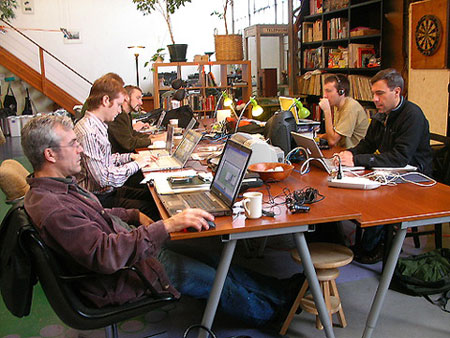
Cool piece in Businessweek about the rising popularity of "co-working" spaces for independent, internet-age freelancers who are burnt out on working from their homes (cons: too isolating, makes you crazy, no work/life boundaries) and don't want to just work out of Starbucks (cons: too public, not networking-conducive, laptop theft, rising price of lattes). Image above, hatfactory in dogpatch, San Francisco.


I said that all in jest of course.

In all honesty... co-working is the future, if only for the simple reason that in a future where we can work and live anywhere we want we all need to get out of the house sometime.

Other interesting trends are community bike shops and tool lending libraries. You might also notice trends with car co-ops and not that these things are are as here to stay as hostels and regular libraries and that they all serve the purpose of stimulating social capital (the base of all economics) by providing providing greater social and economic mobility.

Furthermore another trend is that these things can be done increasingly for profit debunking neo-con remarks about socialism. These newer trends are in infact the finest form of democracy and the free market in action to date as many sharp economists will tell you. Do not be fooled just because money doesn't change hands as in the case of wikipedia does not mean that it's not capitalism.

It reminds me of something Brewster Kale of Archive.org said of his idea of a great libarary of all the world's knowlege. To paraphrase poorly, "Who will fund this alexandria? The free market fund it, it's in businesses best intrest." ... or something like that... what he really said was way better you'll just have to google it.

The truth is there is a parrellel between a culture's economic wealth and providing many of the most basic needs... ie. it's social health. This does not mean people sitting on welfare checks as some idiots might misconstrue. This means...

1) "competing with free" is not only a fundamental prerequisite of modern business, not just intellectual property businesses like Music, but also necesities like water, food, shelter, clothing, education and an increasing array of services. In the U.S. somehow pretty much everyone has access to the necesities like water. Water is in fact free, and yet the water industry is so lucrative even a screw up like Coca-cola with Dasani can make money.

and

2) On some level providing free or cheap open unencumbered access to the tools that make society work is not just good business sense but maybe also a moral imperative. It's not socialist any more than wikipedia is socialist... it's just solid free market economics... give something away for free and hold something in reserve to sell for profit is a fundamental principal of doing business on the internet and the future of all business models. The trick is nowing how much to give away for free vs. how much to hold for sale and profit?

Ramble. Ramble. Ramble.